Twitch chat has its own language. A wall of sleeping faces means the stream has gone quiet. A sweating frog means something bad is about to happen. A single W means chat is cheering you on. Here is what the best-known Twitch emotes and chat slang mean, where they came from and when people reach for them — useful whether you are watching a big stream or decoding chat while you set up your own.
Quick answer
| Emote / slang | What chat is saying | Where it lives |
|---|---|---|
| Kappa | “I’m joking / being sarcastic” | Built into Twitch |
| PogChamp / Pog | “That was hype” | Built into Twitch (face has changed) |
| LUL | “I’m laughing” | Built into Twitch |
| OMEGALUL | “I’m dying laughing” | BetterTTV, FrankerFaceZ, 7TV |
| KEKW | “Hard laughing” | BetterTTV, FrankerFaceZ, 7TV |
| monkaS | “This is tense” | BetterTTV, FrankerFaceZ, 7TV |
| monkaW | “I’m scared, this is worse” | BetterTTV, FrankerFaceZ, 7TV |
| ResidentSleeper | “This is boring” | Built into Twitch |
| KKona | “That was very American” | BetterTTV |
| Copium | “Stop making excuses” | BetterTTV, FrankerFaceZ, 7TV |
| Pepega | “That was dumb” | BetterTTV, FrankerFaceZ, 7TV |
| PepeHands | “That’s heartbreaking” | BetterTTV, FrankerFaceZ, 7TV |
| Sadge | “That’s sad” | BetterTTV, FrankerFaceZ, 7TV |
| Kreygasm | “That was amazing” | Built into Twitch |
| 5Head | “Big brain” (often sarcastic) | BetterTTV, FrankerFaceZ, 7TV |
| catJAM | “This song slaps” | BetterTTV (animated) |
| W / L | Win / loss energy | Plain text in chat |
Kappa
What it means: sarcasm. Put Kappa after a sentence and chat reads it as a joke, a troll or an eye-roll — the Twitch version of a wink.
Where it came from: the grey face is Josh DeSeno, who worked on Justin.tv’s chat client. Staff faces were turned into early emotes, and DeSeno’s smug smile stuck. The name comes from the kappa, a creature in Japanese folklore that DeSeno was into. Twitch later added variants such as KappaPride, KappaClaus, Keepo and MiniK.
How people use it: after a fake compliment, a bad take or anything that should not be taken at face value. “Best play of the year Kappa” usually means the opposite.
PogChamp and Pog
What it means: hype. PogChamp (and the shorter “Pog” or “POGGERS”) is chat’s way of saying a play, clip or announcement just hit.
Where it came from: the original face is fighting-game player Ryan “Gootecks” Gutierrez, frozen mid-surprise in a Cross Counter TV blooper reel uploaded in November 2010. Twitch added it as a global emote in the early 2010s. In January 2021 Twitch removed Gootecks’ face after comments he made about the Capitol riot, briefly rotated other streamers’ faces as PogChamp, then settled on other art (including the KomodoHype komodo dragon many chats still treat as the hype button). Browser extensions often still show older faces when you type PogChamp or PogU.
How people use it: spam on clutches, drops and announcements. People also say “pog” out loud the same way.
LUL
What it means: laughter — Twitch’s LOL.
Where it came from: the face is game critic John Bain, better known as TotalBiscuit, laughing with a hand on his chin. After a photographer’s copyright claim pulled an earlier version, Bain helped get the emote onto BetterTTV, and Twitch later carried LUL as a global emote. Bain died in May 2018; the emote stayed.
How people use it: whenever something on stream is funny. LULW is the zoomed-in extension cousin.
OMEGALUL
What it means: the biggest laugh. OMEGALUL is LUL stretched until the mouth fills the frame — “omega” as in maximum.
Where it came from: a stretched edit of the same TotalBiscuit laugh. It lived on extensions for years and spiked hard after Bain’s death as people flooded chat with it.
How people use it: when LUL is not enough. Chats often spam it in a wall rather than once.
KEKW
What it means: hard, wheezing laughter — closer to “I’m dead” than a polite chuckle.
Where it came from: the face is Spanish comedian Juan Joya Borja, known as El Risitas, mid-laugh in a 2007 TV interview about throwing paella pans into the sea. FrankerFaceZ user Keesual uploaded KEKW in August 2019. The name mixes 4chan’s “kek” (lol) with the wide “W” suffix many extension emotes use. Big meme streams such as xQc’s and AdmiralBulldog’s helped it take over as the default laugh emote. Borja died in 2021.
How people use it: same job as OMEGALUL, and often stacked with it.
monkaS
What it means: tension. The sweating, wide-eyed Pepe face shows up when a round, horror hallway or all-in gamble gets stressful.
Where it came from: artist Matt Furie created Pepe the Frog for his comic Boy’s Club in 2005. The nervous, sweating Pepe drawing was on 4chan by July 2011. On March 16, 2016, a Twitch user then called MonkaSenpai uploaded it to BetterTTV as monkaS — the “monka” name comes from that uploader, and the S is for scared.
How people use it: during clutches, boss fights and IRL moments that feel off. When the panic goes up a notch, chat switches to monkaW.
monkaW
What it means: fear, turned up. monkaW is the zoomed-in version of monkaS. Chat uses monkaS when things get tense and monkaW when they get worse: a dark hallway in a horror game, a 1v4 clutch, a streamer about to gamble everything on one roll.
It also works as sarcasm. If a streamer is far more scared than the moment deserves, expect a wall of monkaW.
Where it came from: same Pepe art as monkaS, cropped tighter. It sits in a family of variants alongside monkaThink, monkaGIGA and monkaOMEGA.
How people use it: on its own, or stacked with monkaS as the tension builds. It is a channel emote, so it only shows in chats that have added it through an emote extension.
ResidentSleeper
What it means: boredom. When ResidentSleeper floods chat, viewers are telling the streamer the last few minutes have dragged. Long loading screens, slow menus and a streamer reading patch notes out loud are classic triggers.
Where it came from: the face belongs to streamer Oddler, who streams as OddlerPro. On September 29, 2012, he fell asleep around hour 66 of a 72-hour Resident Evil marathon, his third and last try at the challenge. The name is Resident Evil plus a sleeper, and viewers voted the moment into an emote later that year.
In June 2016, Twitch said it had been asked to remove ResidentSleeper during a clean-up of its old, low-resolution global emotes. The emote came back, and it is still a global emote that anyone can type in any channel.
How people use it: chat spams it during slow stretches, and also as a jab at a dull play or a long, safe strategy. It stings enough that some streamers ban it. AdmiralBulldog did in 2017, after his chat used it on his PUBG games.
KKona
What it means: “that was very American.” Chat drops KKona when a streamer does or says something that fits the redneck stereotype: monster trucks, fireworks, country music, a proud “yeehaw.”
Where it came from: the face is Kona, a streamer from the Justin.tv days. It is cropped from a 2010 photo of him with actress Danielle Spencer, known for the 1970s sitcom What’s Happening!!, taken at Wizard World Anaheim Comic Con. Kona told the story behind the photo on stream in 2018.
How people use it: KKona is a global emote on BetterTTV, so anyone with the extension sees it in every channel. Without BetterTTV, it shows up as the word “KKona.” Subscribers to Kona’s own channel get a native version plus a golden KKona. You will also see KKonaW, a tighter crop of the same face.
Copium
What it means: cope plus opium. Copium is the imaginary drug people breathe in to get through a loss. When a streamer blames the lag, insists a loss “doesn’t count” or promises the next patch will fix their main, chat answers with Copium, often as “KEK COPIUM” or “COPIUM OMEGALUL.”
Its sibling is hopium, which chat uses for blind optimism that things will magically turn around.
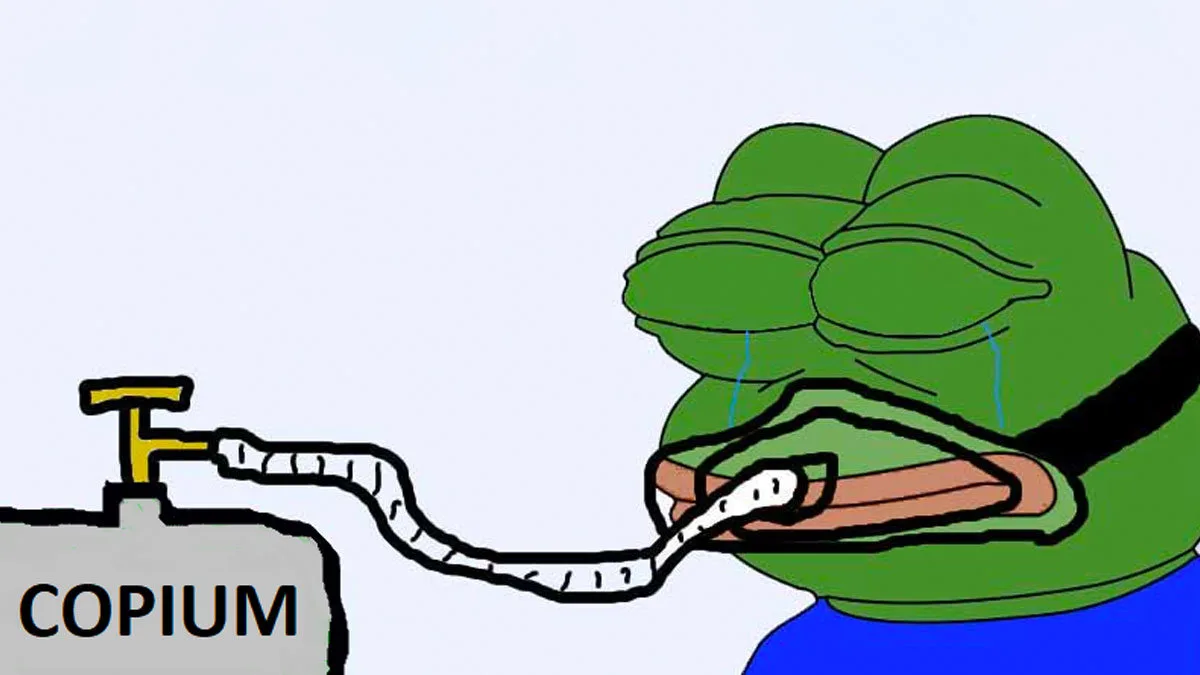
Where it came from: the word is older than Twitch. The earliest known use is the title of rapper Keak da Sneak’s 2003 album Copium. The picture most people know, Pepe crying into a mask hooked up to a tank labelled “COPIUM,” spread as a reaction image in 2020 and became the emote.
How people use it: as a reply to excuses, from viewers and streamers alike. It is teasing, and most streamers take it with a laugh.
Pepega
What it means: “that was dumb.” Pepega is a distorted Pepe the Frog that chat spams when someone misses an easy shot, walks into an obvious trap or throws a round they had won. It is pronounced “peh-PEY-guh.”
Where it came from: Discord user adew posted the first known Pepega on April 8, 2018. The name seems to come from a botched emote code with a missing colon. It was added to FrankerFaceZ the same day. That September it landed in Forsen’s chat, where his community disliked the pick and spammed it in protest, which only made it stick. The “FOR SAN” version, with a horn added, imitates someone yelling Forsen’s name in a goofy voice.
How people use it: mostly as friendly teasing. It can come across as a real insult, though, so read the room before you spam it at someone.
PepeHands
What it means: dramatic sadness. PepeHands is Pepe crying with both hands raised — the emote for a run that dies one room from the end, a soft-locked save or a streamer who just tilted off the face of the earth.
Where it came from: another Matt Furie Pepe edit that Forsen’s community helped push into the mainstream on Twitch. It sits next to FeelsBadMan as a go-to sad reaction, but with more theatrical despair.
How people use it: when something genuinely sad happens on stream, or when chat is being theatrical about a small L.
Sadge
What it means: quiet sadness. Sadge is a small, flattened Pepe looking down — less dramatic than PepeHands, more “aw man.”
Where it came from: an edit of the older Feels Bad Man / Sad Frog Pepe. User Redshell submitted Sadge to BetterTTV on January 3, 2020; it also landed on FrankerFaceZ that month. Forsen and AdmiralBulldog chats helped it spread, and people now say “sadge” out loud the same way they say “pog.”
How people use it: soft disappointment, a wholesome goodbye, or a bittersweet clip. Often pairs with a short “Sadge” in the message.
Kreygasm
What it means: pure joy. Kreygasm is a face frozen in over-the-top delight, and chat uses it for anything that feels too good: an absurd clip, a clutch win, a perfect loot drop, and yes, the occasional suggestive moment.
Where it came from: the face belongs to streamer Kreyg. Justin.tv approached him in March 2011 about turning his face into a global emote. The name “Kreygasm” came up on one of his streams that August, Kreyg took a photo for it, and the emote was in Twitch chat by early September 2011.
How people use it: it is built into Twitch, so it works everywhere, and it is still one of the most recognisable reaction emotes on the site.
5Head
What it means: big brain — sometimes sincere, often sarcastic. Chat drops 5Head on a genius outplay and on a plan so bad it loops back around to funny.
Where it came from: it starts from 4Head, the grinning face of League streamer Cadburry. 5Head is that same face with the forehead stretched comically large. FrankerFaceZ user SublimedTV uploaded it on March 14, 2018. It took off harder once xQc’s chat adopted it for both brilliant and ridiculous plays.
How people use it: after a smart callout, a cursed strategy or anyone saying “hear me out.”
catJAM
What it means: vibing. catJAM is a white cat bobbing its head on beat — chat’s reaction when a song on stream is good.
Where it came from: the animated “Vibing Cat” / “Catjam” meme, cut into a BetterTTV emote around 2020. Because it is animated, you need an extension that supports it.
How people use it: during soundtrack peaks, DJ streams and any moment the audio carries the vibe. People also type “catJAM” in plain text when the emote is not loaded.
W and L in chat
What they mean: win and loss energy, without an emote. A W (or “huge W”) means chat respects a decision, donation, take or play. An L means it flopped. You will also see “W chat,” “L streamer,” “ratio” and “L + ratio” piled on.
Where it came from: plain internet slang that Twitch chat adopted. It is not a global emote — people just type the letter — which is why it shows up the same on Twitch, Kick and Discord.
How people use it: as a quick poll (“chat, W or L?”), a cheer after a good call or a pile-on after a miss. Read the room; spam Ls can tip from teasing into bullying.
Why some emotes show up as plain text
Kappa, PogChamp, LUL, ResidentSleeper and Kreygasm are part of Twitch itself, so everyone sees them. KKona, monkaS, monkaW, Copium, Pepega, PepeHands, Sadge, OMEGALUL, KEKW, 5Head and catJAM come from browser extensions such as BetterTTV, FrankerFaceZ and 7TV, and most are only switched on in channels that added them. If chat looks like a wall of random words, install one of those extensions and the faces appear.
Related reading
For the bigger picture of where people watch, start with our video game streaming statistics and the Kick statistics page. Setting up a stream? Match your canvas to a clean size on the 16:9 resolutions list, then tune aim and mouse feel with the gaming tools hub — DPI analyzer, mouse sensitivity converter and CPS test. Or browse the PC & Tech hub.